


Composable ERP vs. Legacy ERP: How to Modernize Without Replacing Everything
ERP modernization does not always require a full replacement. Many companies can create value faster by making ERP more modular, connected and easier to extend.
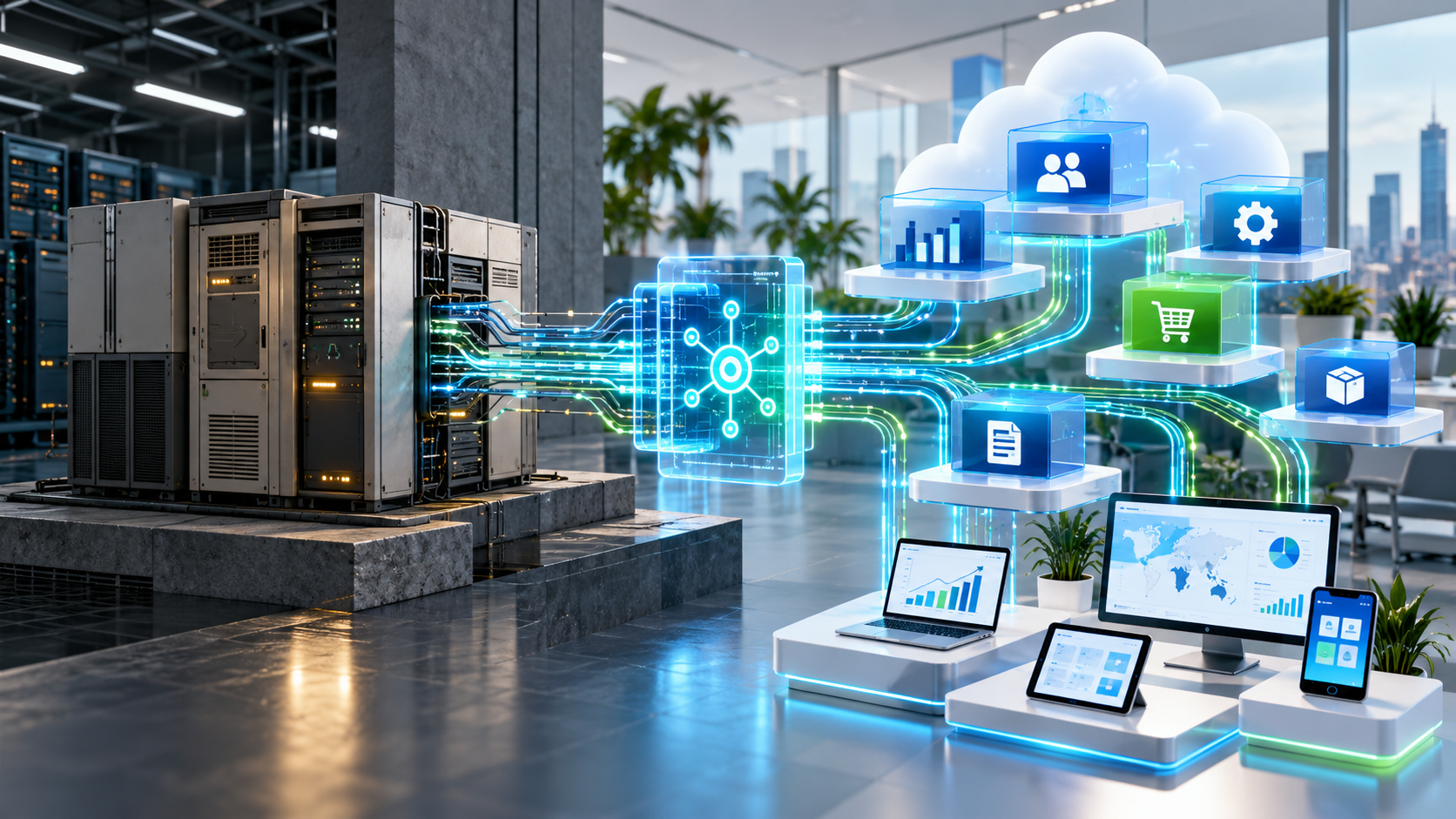
Executive Summary
Legacy ERP often contains the processes that keep a business running, but it can also slow down growth when every change becomes expensive or risky.
Composable ERP keeps core controls stable while modernizing around them with APIs, cloud services, workflow layers and specialized applications.
The Strategic Context
Businesses need ERP stability and digital agility at the same time.
The Core Still Matters
Finance, inventory, procurement and compliance need consistency and auditability.
Change Happens Around the Core
Customer experience, automation and analytics often require faster iteration.
Integration Creates Flexibility
APIs and data platforms let companies extend ERP without brittle customizations.
The Business Problem Beneath the Trend
Many ERP environments carry years of custom code, manual workarounds and point-to-point integrations. The system still works, but it becomes harder to support new channels, reporting needs or automation.
A full replacement may be too costly or disruptive, but doing nothing can leave the business stuck with slow change cycles and disconnected digital experiences.
What Leaders Should Understand
Composable ERP is not a rejection of ERP. It is a recognition that one platform should not carry every business capability. Stable transaction logic can stay in the core while experience, analytics and automation layers evolve around it.
The modernization decision should be based on capability gaps. Which processes truly belong in ERP? Which should move to a commerce, CRM, data or workflow layer? Which customizations can be retired?
A Practical Roadmap
Modernize in layers instead of treating ERP as all-or-nothing.
1. Assess core ERP health
Review customizations, integrations, performance, data quality and support risks.
2. Classify capabilities
Separate controlled core processes from flexible experience and analytics needs.
3. Reduce brittle customization
Replace fragile custom code with APIs, configuration or modular services where possible.
4. Connect surrounding platforms
Integrate commerce, CRM, data, service and workflow systems with reliable data flows.
5. Sequence by value and risk
Create a roadmap that improves outcomes without disrupting essential operations.
Where Value Usually Shows Up
Lower Modernization Risk
Companies can improve gradually instead of forcing one large replacement.
Faster Change
Teams can launch digital capabilities without changing the ERP core every time.
Better Data Flow
Connected architecture improves visibility across operations.
Metrics to Track
- Change request cycle time
- ERP customization count
- Integration failure rate
- Manual workarounds
- Reporting latency
- Process downtime
- User adoption
- Cost to maintain legacy extensions
Common Mistakes to Avoid
Treating the topic as a software purchase
Technology choices should follow workflow design, data ownership, integration needs and measurable business outcomes.
Skipping process redesign
Modern tools applied to old workflows often preserve bottlenecks instead of removing them.
Underinvesting in data quality
Analytics, automation and AI depend on clean definitions, reliable records and clear stewardship.
Measuring implementation instead of outcomes
Track business results such as cycle time, conversion, margin, service quality, risk reduction and user adoption.
NextBits Perspective
NextBits helps companies modernize ERP pragmatically, balancing stability with agility.
Our approach focuses on architecture, integrations, data flows and surrounding applications that improve business value without unnecessary disruption.
Modernize ERP Without Starting Over
NextBits can help define the right ERP modernization roadmap for your business.
Talk to an Expert